


08-26-2025, 06:26 PM
A lot of changes out at the eruption site…
All those keeping track will recall with the ramp up to episode 30 (we just got over phase 31) there was some pilikia with the tilt where instead of a steady increase followed by a sudden decrease as the eruption began there was an odd signature where the tilt wallowed around for a bit..
Initially HVO said of the changes..
From https://www.bigislandvideonews.com/2025/...pisode-31/
where they speculated..
Similar deflation preceded episode 30 and appear to be related to variation in supply rate as there is no indication of any significant movement of magma from the summit region.
And then more recently followed that up with a different interpretation with their
The Fringes And Fractures Of Episode 30 statement as reported here..
https://www.bigislandvideonews.com/2025/...pisode-30/
Which in part states..
Episode 30 began differently than other episodes, with the Uēkahuna Bluff tiltmeter showing deflationary tilt prior to the start of the episode at 12:45 a.m. HST. Ten minutes later, lava first appeared in the north vent and began overflowing it within a minute. At 1 a.m., the Sand Hill tiltmeter began recording rapid tilting away from the caldera and shallow earthquakes began the area just to the south of the Halemaʻumaʻu vents.
Magma then became visible in the south vent at 1:07 a.m. followed by the opening of a new fissure on the south side of Halemaʻumaʻu crater and accompanied by one of the largest earthquakes at 1:12 a.m. The south vent began erupting a minute later followed by the onset of vigorous, high-volume fountaining from the north vent accompanied by strong tremor at 1:20 a.m. At this point, the Sand Hill tiltmeter switched from tilting away from the caldera to inward and the earthquakes stopped.
The combination of the rapid swarm of volcano tectonic earthquakes and the southward tilt of two microradians seen at Sand Hill recorded the opening of a new subsurface crack. Magma rose rapidly within the crack and in less than 12 minutes erupted on the surface creating the new fissure vent opening in Halemaʻumaʻu. This new vent stopped erupting after only 4 hours but still represents a significant change in the eruption.
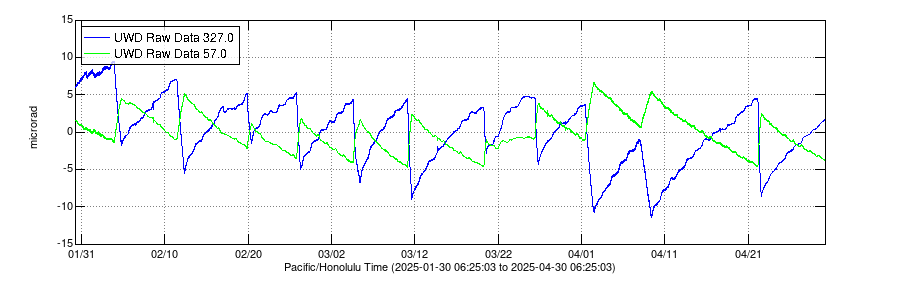
And, meanwhile the summit tilt continues to surprise.. where the followup statement by HVO, which was released before episode 31 and suggests that the odd tilt signal is associated with this new intrusion on the south side of Helemaumau, doesn’t include a description of the same odd tilt signal preceding episode 31 as seen in the tilt signal shown below.. where we see both phase 30 and 31’s trace being very similar. And now to spice stuff up a bit more we have an unusually flat.. no inflation or deflation of note.. signal over the last 24 hours.. smack dab in the middle of what was almost always.. until this point.. a steady inflation in this part of the eruptive cycles..
All those keeping track will recall with the ramp up to episode 30 (we just got over phase 31) there was some pilikia with the tilt where instead of a steady increase followed by a sudden decrease as the eruption began there was an odd signature where the tilt wallowed around for a bit..
Initially HVO said of the changes..
From https://www.bigislandvideonews.com/2025/...pisode-31/
where they speculated..
Similar deflation preceded episode 30 and appear to be related to variation in supply rate as there is no indication of any significant movement of magma from the summit region.
And then more recently followed that up with a different interpretation with their
The Fringes And Fractures Of Episode 30 statement as reported here..
https://www.bigislandvideonews.com/2025/...pisode-30/
Which in part states..
Episode 30 began differently than other episodes, with the Uēkahuna Bluff tiltmeter showing deflationary tilt prior to the start of the episode at 12:45 a.m. HST. Ten minutes later, lava first appeared in the north vent and began overflowing it within a minute. At 1 a.m., the Sand Hill tiltmeter began recording rapid tilting away from the caldera and shallow earthquakes began the area just to the south of the Halemaʻumaʻu vents.
Magma then became visible in the south vent at 1:07 a.m. followed by the opening of a new fissure on the south side of Halemaʻumaʻu crater and accompanied by one of the largest earthquakes at 1:12 a.m. The south vent began erupting a minute later followed by the onset of vigorous, high-volume fountaining from the north vent accompanied by strong tremor at 1:20 a.m. At this point, the Sand Hill tiltmeter switched from tilting away from the caldera to inward and the earthquakes stopped.
The combination of the rapid swarm of volcano tectonic earthquakes and the southward tilt of two microradians seen at Sand Hill recorded the opening of a new subsurface crack. Magma rose rapidly within the crack and in less than 12 minutes erupted on the surface creating the new fissure vent opening in Halemaʻumaʻu. This new vent stopped erupting after only 4 hours but still represents a significant change in the eruption.
And, meanwhile the summit tilt continues to surprise.. where the followup statement by HVO, which was released before episode 31 and suggests that the odd tilt signal is associated with this new intrusion on the south side of Helemaumau, doesn’t include a description of the same odd tilt signal preceding episode 31 as seen in the tilt signal shown below.. where we see both phase 30 and 31’s trace being very similar. And now to spice stuff up a bit more we have an unusually flat.. no inflation or deflation of note.. signal over the last 24 hours.. smack dab in the middle of what was almost always.. until this point.. a steady inflation in this part of the eruptive cycles..