So, I’ve been wondering, how does the current phase of episodic eruptions go from the current pattern of activity to..? How does it end? What follows?
And then yesterday morning, early, there was a shallow (0.5 miles) 3.2 magnitude earthquake located right under the vent site which brought back memories of the day Puu Oo changed from its first few years of episodic high fountains to the low level continuous eruption that went on for years..
I was up on Puu Oo the day it switched from its high volume high fountains episodic phase to what turned out to be decades of continuous low level effusion. A small group of us were out at the eruption site camping up at the vent for 3 days already as the conduct was full to it’s brim with lots of spattering and little spillovers happening, just like we see the beginning of a phase at Halemaumau now. And, instead of the little spillovers evolving into larger and eventually a full blown eruption, all of a sudden, like out of the blue, the magma column literally vanished, along with a small seismic event and a black puff of ash that rose from the vent.
I was in touch with HVO via radio, and was immediately encouraged to get off of Puu Oo and as we descended the cone, keep in mind Puu Oo was big, and the vent itself was over 500 feet higher than the pre-eruptive ground, and as we ran down it’s steep tephra surface, on its west side, the ground before us, off the cone between Puu Oo and Napau Crater opened up and a half mile long fissure erupted. This quickly died down, and by the next day it was over. The following day a very small eruption began at what was to become Kupaianaha.
Upon review what is believed to have happened is that the extension of the conduit from it’s preemptive height to what became a pipe extending the vent 500 feet higher, and as such holding that much more magma, and all of it weighing more and more as the conduit grew, eventually created a scenario where the weight of the magma was too great and instead of more eruptions the pipe itself broke, and magma rushed in to fill the new voids created and found it’s way to the surface through them instead of the standing vent pipe.
In other words, it took a catastrophic failure of the system for the eruptions to change. But why, after the failure, did high fountains not resume? What about the change was so dynamic that now the magma could flow to the surface without interruption, and without being able to accumulate all the volatility that was the hallmark of the earlier phases?
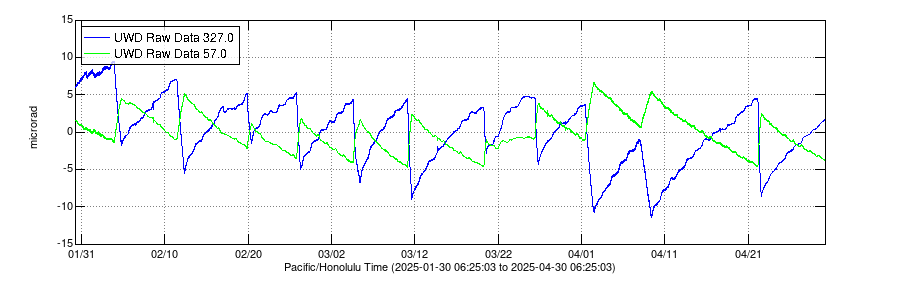
In any event I’ve been wondering.. and then woke up yesterday to a change in the tilt, which began at the point of the earthquake, and remained flat for a few hours before resuming its otherwise inflating profile. Not to say this is solid evidence of anything at the moment, but rather here is a change, marked by a seismic event.. and those are the memories it excited. And, besides the period of no inflation that followed the earthquake, nothing else seemed to have changed. The vent continued to show signs of being full and had several spattering events after the earthquake as before..
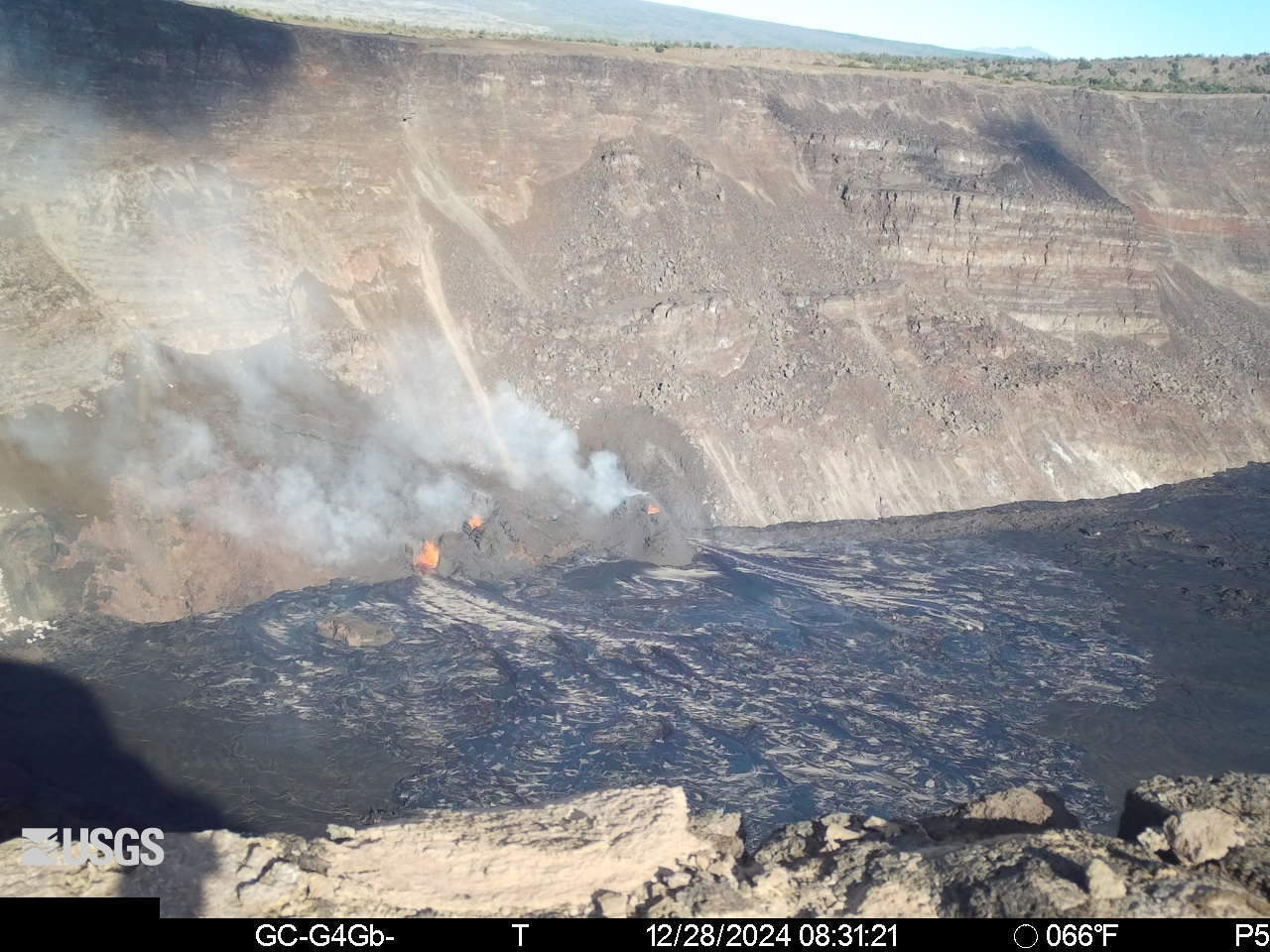
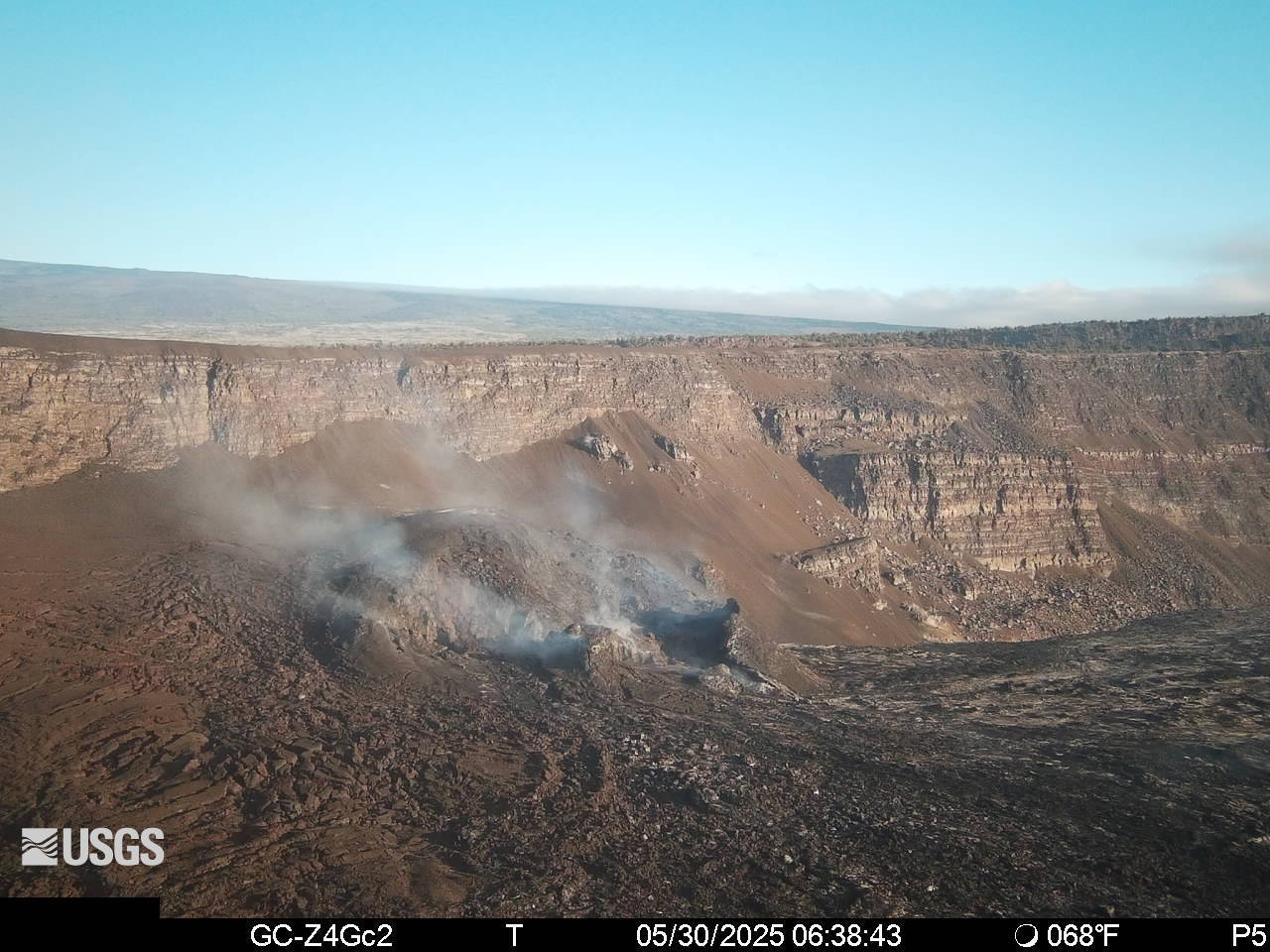
But it did excite that memory, and because of it I wondered, just how high have the vents extended themselves since the onset of this series of eruptions? So, to that point, here is a set of images.. both taken from HVO’s S2cam. One is from the beginning of this series, taken on 12/28/2024 just after the camera was realigned to put the vents in focus, and the other from yesterday. Obviously the camera angle has changed a bit but you can align them by recognizing specific features in the caldera wall around the activity. To me, it looks like the eruptions have extended the ground surface about one third of the way up the caldera wall since all this began.