Posts: 11,242
Threads: 358
Joined: Apr 2009
12-14-2025, 06:00 AM
(This post was last modified: 12-14-2025, 06:00 AM by TomK.)
Unfortunately, the only telescope that could have resolved the thrusters and windows on 3I/Atlas has been delayed due to unforeseen circumstances. So we're left with what we have. Despite not being able to detect the actual thrusters, the jets of particles, ahem, from those thrusters are observable. Obviously, they are not jets of molecules and volatile ices being blown off the comet's icy surface due to heating from the sun, but are well-known interstellar space ship maneuvers to slow down and do whatever the millions-of-years-old aliens planned when they reached our solar system. The 16-hour rotation period is to allow them to look through the windows all over the place because that's how space aliens roll.
https://youtu.be/HwTJSN9vu40?si=AeXKqbuQkRHqpqBM
Posts: 11,242
Threads: 358
Joined: Apr 2009
02-13-2026, 06:26 AM
(This post was last modified: 02-13-2026, 06:34 AM by TomK.)
Massive stars might not become a supernova, but still become a black hole
This one is intriguing. There are a few ways stars can become black holes, but they always require a supernova; the outer layers of the star collapse because the thermal energy from the core stops when it runs out of fuel, or an orbiting star deposits enough material on its companion, and then the companion star collapses under its own gravity. This one is different. In this case, the star just faded into a likely black hole without announcing itself as a supernova. The event orcurred in the Andromeda galaxy.
"Keck Observatory observations help constrain a long-predicted pathway for black hole formation"
" Astronomers using W. M. Keck Observatory on Maunakea, Hawaiʻi Island contributed key observations to the identification of a rare stellar death in which a massive star appears to have collapsed directly into a black hole without first exploding as a supernova. The event occurred in the Andromeda galaxy and provides strong observational support for a long-theorized but rarely confirmed route to black hole formation.
The study, led by researchers at Columbia University, is published in today’s issue of the journal [url=https://www.science.org/doi/10.1126/science.adt4853]Science and combines archival space-based data with targeted ground-based follow-up observations from multiple observatories.
“This has probably been the most surprising discovery of my life,” said Kishalay De, professor of astronomy at Columbia University and lead author of the study. “The evidence of the disappearance of the star was lying in public archival data, and nobody noticed it for years until we picked it out.”"
https://keckobservatory.org/astronomers-...lack-hole/
Posts: 11,242
Threads: 358
Joined: Apr 2009
This is a nice article about a connection between a UKIRT user and the current Artemis II mission:
https://www.newmedia-wi.com/index.php/sh...on-project
" “They asked if there was any possibility they could use a telescope named UKIRT (U.K. Infrared Telescope),” Lederer said. “I was in the Orbital Debris Program office at the time, working on managing the telescope and working with others on this, and so I said, ‘You know, this is a great idea.’”"
That work progressed into using UKIRT to observe the TRAPPIST-1 system with likely four of its seven planets in the Goldilocks zone, i.e., where water exists as a liquid. I've posted about these results earlier in the thread, and Sue and I have remained in touch ever since.
Posts: 12,617
Threads: 821
Joined: Sep 2012
When galaxies collide. Not for awhile, and it will be relatively slow by astronomical distances and speeds.
Astronomers studying a slow-motion collision between two galaxies have uncovered a massive burst of new star formation. The new study co-authored by Dr. R. Pierre Martin, an astronomer at UH Hilo, takes a look at the interaction between two spiral galaxies, NGC2207 and IC 2163.
Using the integral field spectrograph SITELLE at the Canada-France-Hawaiʻi Telescope (CFHT) atop Maunakea, the team analyzed more than 1,000 regions where new stars are forming — a group roughly 20 times larger than any previous study.
The research reveals that the collision, which began 440 million years ago, has ignited star formation up to 10 times the normal rate while dramatically scrambling the chemical composition across both galaxies, according to researchers. After circling one another for another 200 million years, the galaxies are expected to merge into a single galaxy.
https://mauinow.com/2026/03/30/uh-hilo-a...-maunakea/
Posts: 11,242
Threads: 358
Joined: Apr 2009
04-23-2026, 05:54 AM
(This post was last modified: 04-23-2026, 06:01 AM by TomK.)
Press release from yesterday:
"UH discovery on Maunakea sheds light on brown dwarfs"
"Astronomers at the University of Hawaiʻi have precisely measured the age of a nearby Sun-like star and its unusual companion, known as a brown dwarf, an object that falls between a planet and a star. The discovery offers new clues into how brown dwarfs grow and change over time."
Basically, the age of a main-sequence star like our own sun has been measured. Main-sequence stars are very well understood, especially as we have one in our solar system, so this one was estimated to be about 2.3 billion years old. That means the objects orbiting it are also the same age and one of those objects is a brown dwarf, essentially a failed star because it isn't massive enough to initiate nuclear fusion in its core.
In general, the more massive a star is, the shorter its lifetime. When you get to the other end of the scale, the lifetimes are long and much harder to determine because the uncertainty increases. For brown dwarfs, that uncertainty is high unless you know when it was "born," so now we have a scale since this one formed 2.3 billion years ago.
Posts: 11,242
Threads: 358
Joined: Apr 2009
05-04-2026, 03:59 AM
(This post was last modified: 05-05-2026, 01:38 AM by TomK.)
Uranus' two outer rings tell us a little more about the Solar System's formation
This is an interesting study because rings around large gas giants seem common, but their formation is still a bit of a mystery. We all know Saturn has rings, but Jupiter, Neptune, and Uranus also have rings; they're just very faint. Why Saturn has such bright rings and the other gas giants have faint rings is still unknown, but recent observations of Uranus' two outer rings may help.
It turns out the outermost ring scatters blue light - just like Earth's atmosphere. It means the particles causing the scattering are very small. On the other hand, the inner ring shows the characteristic absorption feature of water ice—a broad band centered around 3 microns. It's a feature I know well. It often broadens towards longer wavelengths due to carbonaceous material. It's seen towards the Galactic Center and star-forming regions, but the broadening is not reported in this case.
The hypothesis is that the outer ring consists of small silicates formed from material left over from the formation of the solar system, and the inner ring consists mostly of ice that formed on dust particles over time.
https://keckobservatory.org/uranus-two-outer-rings/
"“ In contrast, the ν ring material is sourced from micrometeorite impacts on and collisions between unseen rocky bodies rich in organic materials, which must orbit between some of the known moons,” said de Pater. “One interesting question is why the parent bodies sourcing these rings are so different in composition.”"
Posts: 11,242
Threads: 358
Joined: Apr 2009
"3I/ATLAS Just Gave Scientists a Rare Look Inside an Interstellar Comet"
This is from https://www.bez-kabli.pl/3i-atlas-just-g...llar-comet which is not a place I think I ever linked to but it's a very interesting read.
3I/ATLAS is the third interstellar object we know about that entered our Solar System. There have likely been millions of others before we had the technology to detect them. However, we now know three objects have visited us from other solar systems because their orbits mean they came from outside the solar system and originated elsewhere in our Galaxy. Unlike the previous two objects, 3I/ATLAS showed all the indications it was a true comet - and iceball that formed in cold but dense enough regions for objects to coalesce. It then passed near our sun, and the comet's outer layers heated and were ejected. Those gases were measured by several telescopes, including the Subaru Observatory on Mauna Kea.
The gases were different from those of other comets we had observed before. Something was different, and it turns out, with help from other observatories, 3I/ATLAS formed in a much colder region than typical for solar system comets.
" Luis E. Salazar Manzano from the University of Michigan, who headed up the ALMA research, described the chemistry as “really sensitive to temperature,” and noted it tends to indicate regions colder than 30 Kelvin—roughly minus 406 Fahrenheit. That’s much colder than where most known solar-system comets originated."
There's more research to be done, though:
" But there are some important caveats. According to the Nature Astronomy team, this deuterium result is based on just one observing window, and ALMA itself didn’t actually pick up normal water above its detection limit during that session. Instead, the water output was estimated using models anchored partly on methanol line data. So the precise ratios may shift as researchers line up results from other dates and telescopes."
Posts: 11,242
Threads: 358
Joined: Apr 2009
For those of you who think they will live forever, you'll likely see Saturn lose its rings.
" Saturn's rings are disappearing — NASA estimates they'll be gone within 100 million years — which means we happen to be alive during the brief window of cosmic history when Saturn has rings at all"
This comes from several studies, which include observations of "ring rain" from the Keck Observatory.
https://spacedaily.com/saturns-rings-are...saturn-ha/
Further observations are underway. Some of this is based on: https://www.science.org/doi/10.1126/science.aat2965, which shows that to understand our solar system and Galaxy, you can't simply rely on a single telescope that does it all; that just isn't possible despite what some people say.
Posts: 11,242
Threads: 358
Joined: Apr 2009
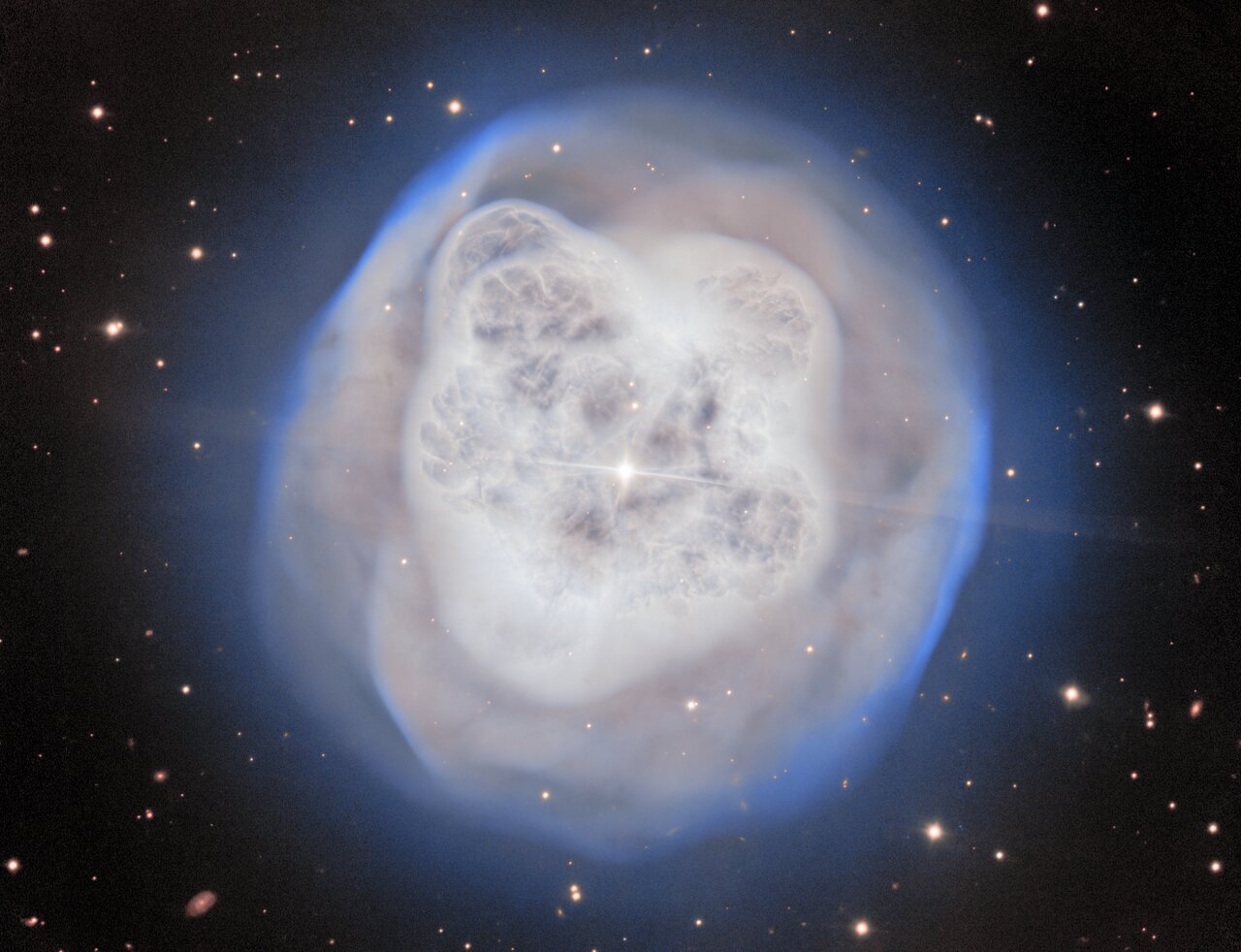
The Crystal Ball Nebula
The Crystal Ball Nebula is a planetary nebula, a term that's misleading and dates back to observations made decades ago. In the past, astronomers who didn't have the tools we have today saw this as fuzziness around a star through their ancient optics and thought it was planets orbiting a star. Today, we know they are dying stars that have run out of hydrogen fuel, and as that happens, the outer layers are blown off the star's surface as each heavier element is depleted. This will happen to our own sun one day.
In this case, the dying star has a companion in orbit, which produces a very strange, beautiful, and chaotic nebula that has been captured by Gemini North on Mauna Kea.
https://noirlab.edu/public/news/noirlab2...cache=true&
|